
Ethical Dilemma in the Use of Artificial Intelligence: Perceptions of Educational Science Students
DOI:
https://doi.org/10.58594/rtest.v6i3.242Keywords:
Artificial intelligence, academic ethics, higher education, digital competenciesAbstract
The objective of this research was to diagnose and analyze the perceptions of students in the Bachelor of Science in Education program at a public university in central Mexico regarding the ethical dilemma generated by the implementation of artificial intelligence in higher education academic activities during 2025. A quantitative approach was used, with a non-experimental, cross-sectional, and descriptive design. The sampling method was non-probabilistic and discretionary, and fifty students participated. Data was collected using a questionnaire consisting of twenty-eight questions distributed across nine analytical categories. The reliability of the instrument was verified using Cronbach's alpha, yielding a value of 0.869. Among the results, it is noteworthy that 2% of the sample always uses artificial intelligence for their academic work, 48% frequently, 38% sometimes, and 12% rarely. While ChatGPT was the most preferred virtual assistant, with 74% of participants choosing it, followed by Gemini AI, Claude, Microsoft Copilot, and Perplexity, this data demonstrates that future education professionals are familiar with the use of artificial intelligence-based tools. This highlights the need to strengthen training in digital skills, redirect teaching methods, and raise student awareness to prevent dishonest practices.
Downloads
References
Aguilar Fernández, E., Zamora Araya, J. A., & Guillén Oviedo, H. S. (2021). Alfabetización, razonamiento y pensamiento estadísticos: Competencias específicas que requieren promoverse en el aula. IE Revista de Investigación Educativa de la REDIECH, 12, e1118. https://doi.org/10.33010/ie_rie_rediech.v12i0.1118 DOI: https://doi.org/10.33010/ie_rie_rediech.v12i0.1118
Barriga Arizabala, J. G., Guerrero Jirón, J. R., Rogel Gutiérrez, E. M., & Martillo Santander, F. E. (2024). Uso de la inteligencia artificial en la educación superior. Polo del Conocimiento, 9(3), 1373–1386. https://polodelconocimiento.com/ojs/index.php/es/article/view/6723/16835
Bauman, Z. (2003). Modernidad líquida. Fondo de Cultura Económica.
Bracho-Fuenmayor, P. L. (2024). Ética y moral en la educación superior: Una revisión bibliométrica. Revista de Ciencias Sociales, 30(3), 553–568. https://doi.org/10.31876/rcs.v30i3.42695 DOI: https://doi.org/10.31876/rcs.v30i3.42695
Cáceres-Mesa, M. L. (Comp.). (2026). Educación Superior en tiempos de inteligencia artificial: pedagogía, evaluación y bienestar. Sophia Editions.
Calderón-Figueroa, C., Marín-Loor, R., Díaz-Campozano, E., & Proaño-Molina, M. (2024). Inteligencia artificial en la educación superior. Dominio de las Ciencias, 10(3), 753–763. https://dominiodelasciencias.com/ojs/index.php/es/article/view/3952
Castillo, B., Calderón, A., Humanante, M., Chang, C., & Ojeda, J. (2024). La inteligencia artificial como recurso educativo en educación superior: Perspectivas éticas sobre su uso. Ciencia Latina Revista Científica Multidisciplinar, 8(4), 3950–3965. https://doi.org/10.37811/cl_rcm.v8i4.12622 DOI: https://doi.org/10.37811/cl_rcm.v8i4.12622
Del Cisne Loján, M., Antonio Romero, J., Sancho Aguilera, D., & Yajaira Romero, A. (2024). Consecuencias de la Dependencia de la Inteligencia Artificial en Habilidades Críticas y Aprendizaje Autónomo en los Estudiantes. Ciencia Latina Revista Científica Multidisciplinar, 8(2), 2368-2382. https://doi.org/10.37811/cl_rcm.v8i2.10678 DOI: https://doi.org/10.37811/cl_rcm.v8i2.10678
Gallent-Torres, C., Zapata-González, A., & Ortego-Hernando, J. (2023). El impacto de la inteligencia artificial generativa en educación superior: Una mirada desde la ética y la integridad académica. RELIEVE. Revista Electrónica de Investigación y Evaluación Educativa, 29(2). https://doi.org/10.30827/relieve.v29i2.29134 DOI: https://doi.org/10.30827/relieve.v29i2.29134
García, O. (2023). Uso y percepción de ChatGPT en la educación superior. Revista de Investigación en Tecnologías de la Información, 11(23), 98–107. https://doi.org/10.36825/RITI.11.23.009 DOI: https://doi.org/10.36825/RITI.11.23.009
García-Peñalvo, F., Llorens-Largo, F., & Vidal, J. (2024). La nueva realidad de la educación ante los avances de la inteligencia artificial generativa. RIED-Revista Iberoamericana de Educación a Distancia, 27(1), 9–39. https://doi.org/10.5944/ried.27.1.37716 DOI: https://doi.org/10.5944/ried.27.1.37716
Hernández-Sampieri, R., & Mendoza, C. P. (2018). Metodología de la investigación: Las rutas cuantitativa, cualitativa y mixta. McGraw-Hill Education.
Juca-Maldonado, F. (2023). El impacto de la inteligencia artificial en los trabajos académicos y de investigación. Revista Metropolitana de Ciencias Aplicadas, 6(1), 289–296. https://www.redalyc.org/articulo.oa?id=721778121031 DOI: https://doi.org/10.62452/8nww1k83
López-Garay, L. (2010). La valoración de la inteligencia humana según Jean Piaget. Revista Pedagogía, 43(1), 35–57. https://doi.org/10.54114/reduca.v43n1.16573 DOI: https://doi.org/10.54114/reduca.v43n1.16573
Macías, R., Solorzano, L., Choez, C., & Blandón, B. (2023). La inteligencia artificial: Análisis del presente y futuro en la educación superior. Revista G-ner@ndo, 4(1), 861–887. https://revista.gnerando.org/revista/index.php/RCMG/article/view/98
Medina, M. (2024). Aplicaciones de la inteligencia artificial para la investigación y la innovación en la educación superior. Revista Social Fronteriza, 4(4), e44336. https://doi.org/10.59814/resofro.2024.4(4)336 DOI: https://doi.org/10.59814/resofro.2024.4(4)336
Morán-Ortega, S., Ruiz-Tirado, S., Simental-López, L., & Tirado-López, A. (2024). Barreras de la inteligencia artificial generativa en estudiantes de educación superior: Percepción docente. Revista de Investigación en Tecnologías de la Información, 12(25), 26–37. https://doi.org/10.36825/RITI.12.25.003 DOI: https://doi.org/10.36825/RITI.12.25.003
Mujica-Sequera, R. (2024). Clasificación de las herramientas de la inteligencia artificial en la educación. Revista Tecnológica-Educativa Docentes 2.0, 17(1), 31–40. https://doi.org/10.37843/rted.v17i1.513 DOI: https://doi.org/10.37843/rted.v17i1.513
Olmedo, R. A., Reinoso, H. R., Herrera, G. C., & Olmedo, A. A. (2025). Competencias digitales del docente: Perspectivas y desafíos para la educación superior. Bibliotecas. Anales de Investigación, 21(1), 1–13. https://dialnet.unirioja.es/descarga/articulo/10159743.pdf
Orosco-Fabian, J., Pomasunco-Huaytalla, R., Gómez-Galindo, W., & Rosales-Puchoc, A. (2025). Prácticas y causas del ciberplagio en personas estudiantes universitarias peruanas. Innovaciones Educativas, 27(42), 254–276. https://www.scielo.sa.cr/pdf/rie/v27n42/2215-4132-rie-27-42-254.pdf DOI: https://doi.org/10.22458/ie.v27i42.5326
Paz-Enrique, L. (2023). Citas fantasma en artículos científicos: Problemática creciente ante el uso de la inteligencia artificial. Revista Médica Electrónica, 45(6), 892–897. https://www.redalyc.org/journal/3782/378277446001/378277446001.pdf
Piedra-Castro, W., Cajamarca-Correa, M., Burbano-Buñay, E., & Moreira-Alcívar, E. (2024). Integración de la inteligencia artificial en la enseñanza de las ciencias sociales en la educación superior. Journal of Economic and Social Science Research, 4(3), 105–126. https://doi.org/10.55813/gaea/jessr/v4/n3/123 DOI: https://doi.org/10.55813/gaea/jessr/v4/n3/123
Sattari-Ardabili, F., & De Hoyos-Guevara, A. J. (2026). Inteligencia artificial en la investigación científica: un análisis desde la perspectiva de la ética y la responsabilidad. Sophia Research Review, 3(1), 50-56. https://doi.org/10.64092/6qseba44 DOI: https://doi.org/10.64092/6qseba44
Torres, R. (2023). Los riesgos y los desafíos que enfrentan los trabajadores frente al uso de la inteligencia artificial en el trabajo. Revista de Derecho Procesal del Trabajo, 6(7), 289–313. https://doi.org/10.47308/rdpt.v6i7.778 DOI: https://doi.org/10.47308/rdpt.v6i7.778
Viracocha, K. (2024). La inteligencia artificial y su impacto en la educación superior y la legislación ecuatoriana [Tesis de licenciatura, Universidad Estatal de Bolívar].
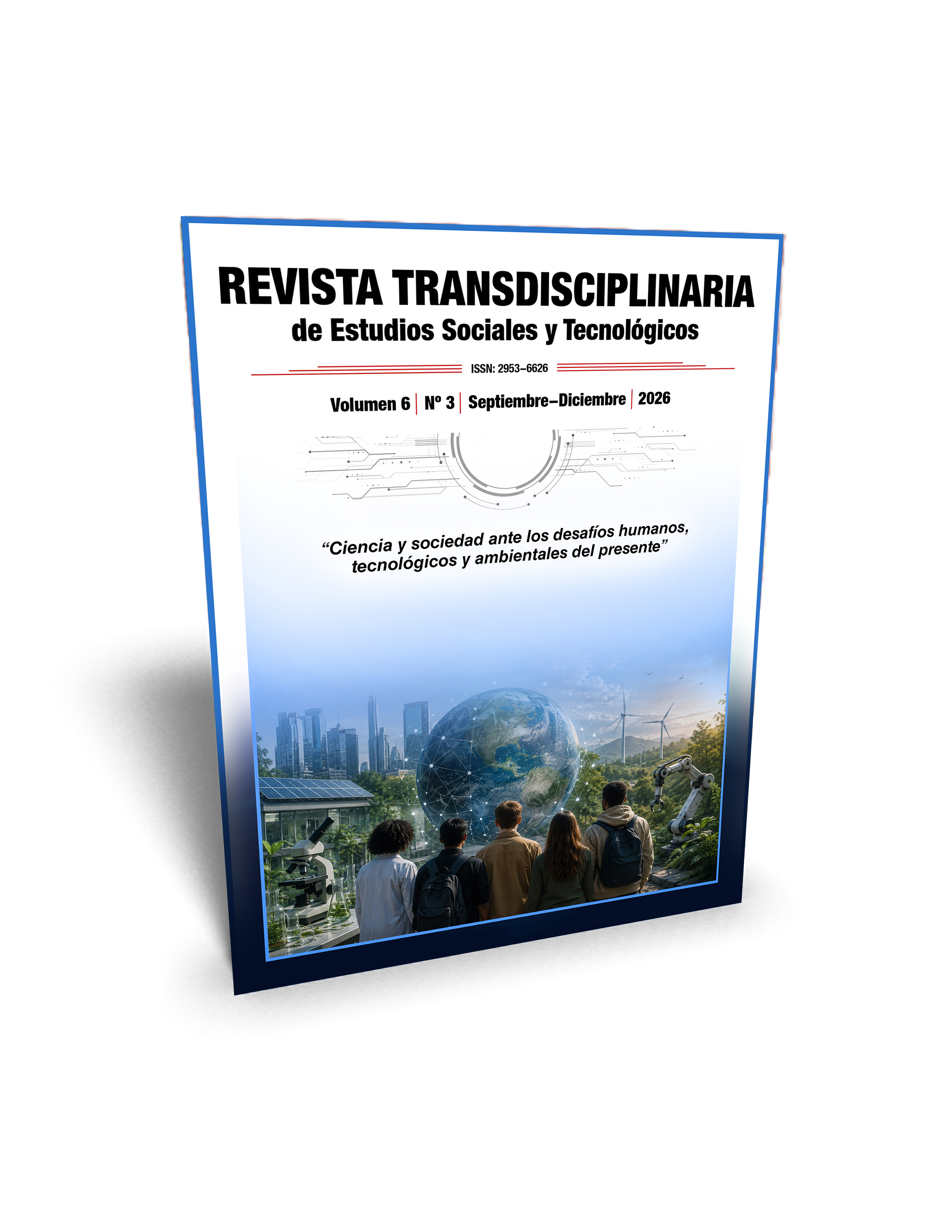
Downloads
Published
How to Cite
Issue
Section
License
Copyright (c) 2026 Abigail Angeles Maturano, Javier Moreno-Tapia

This work is licensed under a Creative Commons Attribution-NonCommercial-ShareAlike 4.0 International License.
Authors who publish in Revista Transdisciplinaria de Estudios Sociales y Tecnológicos (RTEST), agree to the following terms:
1. Copyright
Authors retain unrestricted copyright to their work. Authors grant the journal the right of first publication. To this end, they assign the journal non-exclusive exploitation rights (reproduction, distribution, public communication, and transformation). Authors may enter into additional agreements for the non-exclusive distribution of the version of the work published in the journal, provided that acknowledgment of its initial publication in this journal is given.
© The authors.
2. License
The articles are published in the journal under the Creative Commons Attribution-NonCommercial-ShareAlike 4.0 International License (CC BY-NC-SA 4.0). The terms can be found at: https://creativecommons.org/licenses/by-nc-sa/4.0/deed.en
This license allows:
- Sharing: Copying and redistributing the material in any medium or format.
- Adapting: Remixing, transforming, and building upon the material.
Under the following terms:
- Attribution: You must give appropriate credit, provide a link to the license, and indicate if any changes were made. You may do this in any reasonable manner, but not in any way that suggests the licensor endorses or sponsors your use.
- NonCommercial: You may not use the material for commercial purposes.
- ShareAlike: If you remix, transform, or build upon the material, you must distribute your creation under the same license as the original work.
There are no additional restrictions. You may not apply legal terms or technological measures that legally restrict others from doing anything the license permits.













