
Social inclusion and values: a study from culture
DOI:
https://doi.org/10.58594/rtest.v4i2.119Keywords:
Diversity, social inclusion, values, cultureAbstract
Nowadays, studies in this area of knowledge proliferate and the criteria in this regard are diverse. In this research, emphasis is placed on the main concepts, their importance and relationship from different points of view according to the authors. There is a series of deeply rooted values in our society, shared values that even make it difficult to accept it from a positive vision of diversity, and it is also recognized by some researchers that it does not have to be an obstacle for a group of people, with specific characteristics learn, but with the right and adequate guidance it can be a motivating and energizing factor for the development of learning of the specific group in question. In order to achieve the proposed objective, a theoretical and descriptive analysis is carried out that shows the different approaches and values that highlight inclusion in accordance with the social demand of these times.
Downloads
References
Ariel, U. (2024). ¿Qué es y cuál es la importancia de la diversidad, equidad y inclusión en el mundo tech? https://community.listopro.com/que-es-y-cual-es-la-importancia-de-la-diversidad-equidad-e-inclusion-en-el-mundo-tech/
Ávila Reverón, C. A., Llombet Rodríguez, V. L., & Hernández Hernández, C. H. (2017). La inclusión escolar de los niños con necesidades especiales. (Tesis de Grado). Universidad de La Laguna.
Blanco, R. (2006). La equidad y la inclusión social: uno de los desafíos de la educación y la escuela hoy. REICE Revista Electrónica Iberoamericana sobre Calidad, Eficacia y Cambio en Educación, 4(3), 1-15. https://www.redalyc.org/pdf/551/55140302.pdf DOI: https://doi.org/10.15366/reice2006.4.3.001
Booth, T., & Ainscow, M. (2002). Índice de inclusión: Desarrollando el aprendizaje y la participación en las escuelas. UNESCO. https://unesdoc.unesco.org/ark:/48223/pf0000138159
Del Carmen Martín, L. M. (2000). La atención a la diversidad: una cuestión de valores. Aula de innovación educativa. 90, 7-11. https://dialnet.unirioja.es/ejemplar/16610
Espín, A., & Mera, M. (2019). La Inclusión desde un enfoque de Derechos Humanos en estudiantes con Necesidades Educativas Especiales Asociadas o no a una Discapacidad. Revista Publicando, 6(21), 34-47. https://revistapublicando.org/revista/index.php/crv/article/view/2030
Fernández Bereau, V. B., López Rodríguez del Rey, M. M., & Pérez Pérez, E. (2022). La inclusión: principio de la responsabilidad social de la universidad. Revista Universidad y Sociedad, 14(2), 311-320. http://scielo.sld.cu/scielo.php?script=sci_arttext&pid=S2218-36202022000200311&lng=es&tlng=es.
González Alberteris, A. D., & Rojas Sánchez, H. A. (2023). Formación de valores ambientales en estudiantes universitarios ecuatorianos: hacia una sociedad sostenible. Revista Episteme y Praxis, 1(3), 58-66. https://epistemeypraxis.org/index.php/revista/issue/archive DOI: https://doi.org/10.62451/rep.v1i3.33
González Martínez, L. (1998). Educación, Valores y Democracia. Revista Electrónica Sinéctica, 12, 1-9. http://www.redalyc.org/articulo.oa?id=99826006004
Guédez, V. (2005). La diversidad y la inclusión: Implicaciones para la Cultura y la Educación. Revista SAPIENS, 6(1), 107-132. https://ve.scielo.org/scielo.php?script=sci_arttext&pid=S1317-58152005000100007&lng=es&nrm=iso&tlng=es
Herrera Pérez, G. A. (2022). Los valores de la inclusión. https://www.quadratin.com.mx/opinion/los-valores-de-la-inclusion/
Molina Marín, G. (2019). Valores inclusivos compartidos por la comunidad educativa del Instituto Montenegro (Quindío, Colombia): una aproximación desde los maestros. Revista Internacional de Apoyo a la Inclusión, Logopedia, Sociedad y Multiculturalidad, 5(1). https://revistaselectronicas.ujaen.es/index.php/riai/article/view/4553 DOI: https://doi.org/10.17561/riai.v5.n1.6
Muñoz Ponce, H. J., Mantilla Vivas, A. M., Pico Macías, M. E., Moreira Zambrano, V., & Altamirano Pérez, H. R. (2022). Valores de inclusión, equidad y justicia social en la Formación Profesional. Revista Educare. Versión electrónica. No extraordinario. https://revistas.investigacion-upelipb.com/index.php/educare/article/view/1711 DOI: https://doi.org/10.46498/reduipb.v26iExtraordinario.1711
Organización de las Naciones Unidas para la Educación, la Ciencia y la Cultura. (2008). La educación inclusiva: el camino hacia el futuro. Conferencia Internacional de Educación. UNESCO. https://bibliotecadigital.mineduc.cl/handle/20.500.12365/17483
Organización de las Naciones Unidas para la Educación, la Ciencia y la Cultura. (2021). La inclusión en la educación: una crisis muy útil. https://es.unesco.org/futuresofeducation/ideas-lab/inclusion-educacion-crisis-util
Organización de las Naciones Unidas. (2016). Agenda 2030 y los Objetivos de Desarrollo Sostenible. Una oportunidad para América Latina y el Caribe. MEC-EDUPAZ, 1(11). http://mecedupaz.unam.mx/index.php/mecedupaz/article/view/58871
Ricardo Marrero, D., & Méndez Santos, I. E. (2019). Aproximación a los valores del educador ambiental. Revista Humanidades Médicas, 19(1), 160-179. http://scielo.sld.cu/scielo.php?script=sci_arttext&pid=S1727-81202019000100160
Sebastián Heredero, E., & Lara, P. T. (2020). Desafíos de la inclusión en la Educación Superior: reflexiones internacionales sobre prácticas educativas transformadoras. Revista Educação Especial, 33(70), 1-18. https://www.redalyc.org/journal/3131/313162288070/html/ DOI: https://doi.org/10.5902/1984686X48224
Tejeda Cerda, P. (2019). La evaluación educativa en estudiantes en situación de discapacidad en la universidad: desafíos y propuestas. Estudios Pedagógicos, 45(2), 169-178. https://doi.org/10.4067/S0718-07052019000200169 DOI: https://doi.org/10.4067/S0718-07052019000200169
Urzúa, S. (2018). La batalla contra la desigualdad en Chile. Santiago de Chile: Libertad y Desarrollo. https://lyd.org/wp-content/uploads/2018/06/SISO-173-La-batalla-contra-la-desigualdad-en-Chile-Mayo2018.pdf DOI: https://doi.org/10.2307/j.ctt20fw8bp.8
Varguillas Carmona, C.S., Urquizo Alcívar, A.M., Bravo Mancero, P. C., & Moreno Aguirre, P. E. (2021). Experiencias en el proceso de inclusión educativa en la Educación Superior Iberoamericana. CHAKIÑAN Revista de Ciencias Sociales y Humanidades, 15, 180-195. https://www.researchgate.net/publication/362646627 DOI: https://doi.org/10.37135/chk.002.15.12
Yánez, R. M., & Zavarce, C. (2011). Sustainable development, university and knowledge management from a luhmannian perspective. Revista Iberoamericana de Ciencia Tecnología y Sociedad, 6(17), 105-138. http://www.scielo.org.ar/scielo.php?script=sci_arttext&pid=S1850-00132011000100006&lng=es&tlng=en
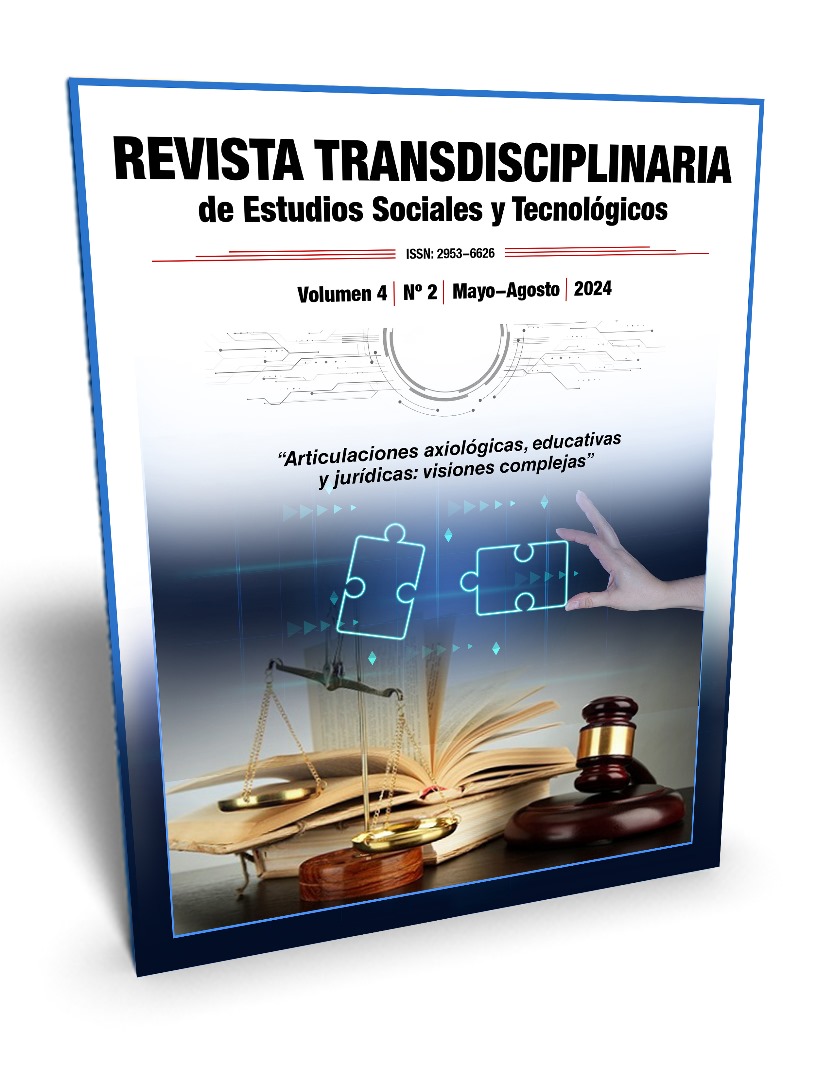
Downloads
Published
How to Cite
Issue
Section
License
Copyright (c) 2024 Rolando Eduardo Medina-de la Rosa, Ana de Lourdes Torralbas-Blazquez

This work is licensed under a Creative Commons Attribution-NonCommercial-ShareAlike 4.0 International License.
Authors who publish in Revista Transdisciplinaria de Estudios Sociales y Tecnológicos (RTEST), agree to the following terms:
1. Copyright
Authors retain unrestricted copyright to their work. Authors grant the journal the right of first publication. To this end, they assign the journal non-exclusive exploitation rights (reproduction, distribution, public communication, and transformation). Authors may enter into additional agreements for the non-exclusive distribution of the version of the work published in the journal, provided that acknowledgment of its initial publication in this journal is given.
© The authors.
2. License
The articles are published in the journal under the Creative Commons Attribution-NonCommercial-ShareAlike 4.0 International License (CC BY-NC-SA 4.0). The terms can be found at: https://creativecommons.org/licenses/by-nc-sa/4.0/deed.en
This license allows:
- Sharing: Copying and redistributing the material in any medium or format.
- Adapting: Remixing, transforming, and building upon the material.
Under the following terms:
- Attribution: You must give appropriate credit, provide a link to the license, and indicate if any changes were made. You may do this in any reasonable manner, but not in any way that suggests the licensor endorses or sponsors your use.
- NonCommercial: You may not use the material for commercial purposes.
- ShareAlike: If you remix, transform, or build upon the material, you must distribute your creation under the same license as the original work.
There are no additional restrictions. You may not apply legal terms or technological measures that legally restrict others from doing anything the license permits.













